

495 to Harvard?
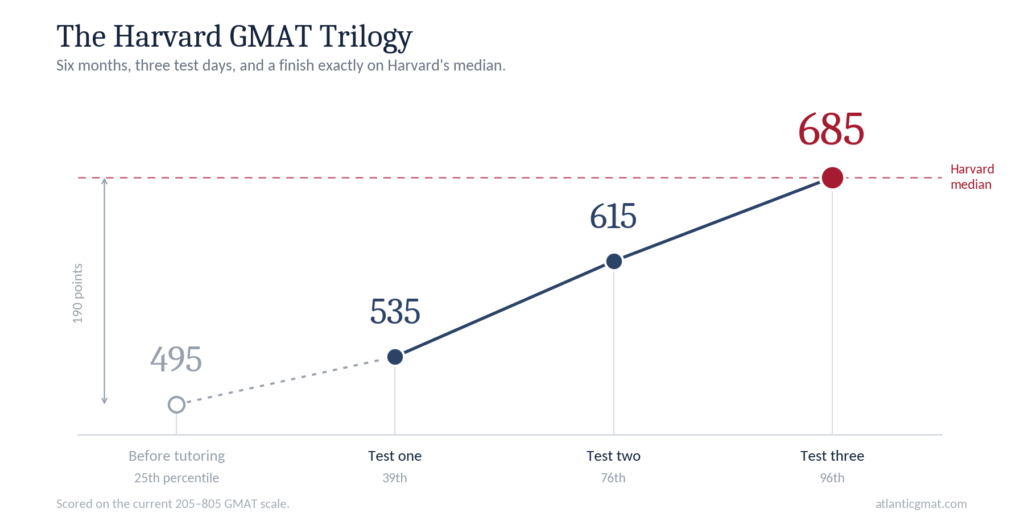
Thomas was a non-native English speaker who I worked with over 6 months. He had already taken 2 GMAT classes but his best GMAT score, a 495, was nearly 200 points away from the Harvard median. Within the first 5 minutes of our meeting he made it clear that he was shooting for Harvard, Stanford, or Wharton. The rest he said: a waste of time. Over 6 months of GMAT preparation Thomas achieved a 685 on his GMAT. Read on for all the gritty details of our 6 months in the GMAT trenches…
A slow start
All of Thomas’s Harvard ambition on display in our first meeting didn’t translate into him getting much homework done. He wasn’t the worst student but it certainly didn’t feel like that 190 point gap to a Harvard GMAT score was disappearing in a hurry. Like most of my GMAT tutoring students he had a demanding job and found it very challenging to balance work and GMAT. It’s tough. The GMAT is a hungry beast. I made his GMAT schedule easier but still the work would come in spurts and not in the consistent and organized way that actually translates into epic Harvard GMAT scores. After two months he had improved on paper with scores grazing 645, but still he would occasionally bomb a section.
When test day came we were throwing out a prayer. A hail mary as we call it. Was that Harvard GMAT score forthcoming? I thought there was the tiniest chance that if everything was perfect he just might squeak by with a 645. Nope. 535. His Quant had gone from a consistent 79 to a 71 on the real test. It was a disaster. Harvard looked rather far away. We were both disappointed. What had happened? To Thomas the test had been a walk in the park. Easy. His only indication that the test had been difficult was the shocking score. My guess is that he had done a lot of shallow analysis on his GMAT. This type of thinking led him to the sucker answers that tempt many MBA hopefuls from the path to GMAT glory. Why was Thomas guilty of shallow thinking? He really hadn’t prepared consistently to the point where he felt really solid on all of his fundamentals. I was able to teach him GMAT skills but he didn’t have the confidence to dig deeper in order to apply those skills. Here’s an article on building GMAT confidence.
Shock as a motivator
The 535 really shook Thomas. He realized that all of my encouraging him to get organized was critical for him to achieve his amazing GMAT score. Luckily, Thomas still had plenty of Harvard level ambition. Mostly because he had spoken with a Harvard admissions officer who had made it very clear that regardless of how great his resume was that without a score up around the 685 median his chances of admission to those hallowed halls were rather slim. Also working for us was a mutual trust. He had not achieved even close to the score that he was after but I believed that he could do it and he felt confident that I could help him get there.
At this point Thomas had been working on his GMAT for about 8 months. Long term GMAT preparation is tricky. Not only is it mentally exhausting but you can run out of GMAT practice materials. Staying organized helps with the mental exhaustion. Make a GMAT study plan. Compartmentalize your studying. Plan time off from studying to rest your brain.
Running out of GMAT Materials
There is an ocean of non-official GMAT materials most of which I wouldn’t touch with a ten foot pole. There are some things that I can recommend. For extra Quant practice I can endorse the GMAT Club Quant CATs. The only problem is that these tests are so tough that you can only really use them if you are already scoring well (around a Q78). Considering how challenging these tests are, before you approach them, it might helpful to read this article on reviewing impossible GMAT questions.
I would avoid third party verbal questions. It is really tough to write verbal questions that are of the same quality and flavor as GMAT questions. Official LSAT questions provide an excellent alternative, especially since GMAT verbal is nothing but reading comprehension and critical reasoning. LSAT questions are similar to GMAT questions except that they are generally tougher. There are literally thousands of LSAT Logical Reasoning and Reading Comprehension Questions. To Thomas’s chagrin I assigned a host of them.
Data Insights is the hard one to stock up on. There is very little decent third party material and the official questions run out fast. The saving grace is that data sufficiency now lives in DI, so good quant work carries over and, if you’re clever about it, there is a ton of official Data Sufficiency practice out there. So part of mastering DI is getting the DS absolutely perfect.
An Almost Harvard GMAT
For non-quants there is a mystique surrounding the GMAT Quantitative section. This aura draws GMAT students into the idea that they should spend more time studying for the Quant than for the Verbal and the Data Insights. The other factor that causes Verbal slacking is that Verbal practice can be very boring. For Thomas I recommended a balanced approach (as I normally do unless there’s some very special circumstance) knowing that with three equally weighted sections a strong verbal performance can do wonders for the composite score. Fortunately, Thomas put in a bunch of work on his Quant and got some real confidence in his abilities but he slacked on the verbal practice. GMAT day: 615
Thirsty for the median
Thomas was invigorated as he saw the finish line (and the last piece of the puzzle for his Harvard application) 70 points away. Although, between us: those 70 points between 615 and 685 are elusive. That stretch takes you from the 76th percentile to the 96th. Regardless of the challenges ahead it was encouraging to see the forward momentum and his 495 baseline in the rear view mirror.
During the last 10 days Thomas buckled down and made a strong, no holds barred, in it to win it push, especially in the verbal. He took that time off from work and spent those last days solely focusing on his GMAT studies so that he could really give this last GMAT a “Harvard try”. Harvard GMAT score here we come! Thomas was nervous about taking a “real” exam. When you’ve put a bunch of work in it can be nerve racking to anticipate whether those hundreds of hours have actually paid off. Practice Exam 3: 665. After taking it Thomas said “getting to 685 is really hard”. He now understood the amount of focus and dedication that he needed. Practice Exam 4: 675.
Rockets to Harvard
Thomas was the most outwardly anxious about this third test. He was sweating this one. Probably because he finally felt that he had put in enough work to be truly prepared to claim his Harvard GMAT score. So this was the true test. Being nervous and anxious is an OK thing. That just means that you care about what you are doing. He said that if he didn’t hit the median this time that he would keep studying and leave Harvard for the next admission cycle. Great attitude! On his GMAT day Thomas recorded a whopping 190 point ascent: 685. Q86 V84 DI82. Right on the Harvard median.
Fast forward to admissions
Stanford GSB success! Though Harvard was the initial goal, after a bunch of school visits, interviews, and just general soul searching, Stanford ended up being the better fit.